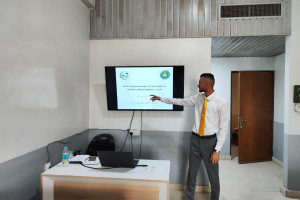
A master's thesis at the College of Agriculture, University of Basra, investigated "The Response of Egyptian Clover Genetic Varieties to Different Seed Rates and Estimating Their Forage Value."
The thesis, presented by researcher Saif Khalil Abdul Zahra, aimed to evaluate the performance of four Egyptian clover varieties and determine the effect of seeding rates on yield and quality characteristics.
The thesis recommended cultivating the Sumer and Misqawi varieties due to their superiority in producing the highest green and dry forage yields and the best quality. A seeding rate of 45 kg ha⁻¹ was used, as these varieties achieved the highest green and dry forage yields and the best quality. The results also called for expanding the cultivation of the Misqawi and Sumer varieties to ensure the sustainability of forage production.
Media and Government Communication Division / College of Agriculture
Important News
viewed most